


Nothing on a paddle board stays dry by accident. A board has no hull, no hatch and no cabin, so everything you take with you sits in the open, inches above the water.
A dry bag costs between seven and forty dollars and turns that problem into a non-problem. Roll the top three times, clip it, and the contents survive a swim.
There are three shapes worth owning. A classic roll top sack for clothes and a towel, a backpack version for anything you carry to the water on foot, and a phone-sized pouch for the things that ride with you rather than on the deck.
We compared nine bags on the things that decide whether a bag actually keeps water out: material thickness, seam construction, and whether the closure survives being sat on.


The best dry bags for paddle boarding at a glance
| Bag | Capacity | Carry | Standout feature |
|---|---|---|---|
| Earth Pak Waterproof Dry BagTop pick | 10 to 55 L | Adjustable shoulder strap | 500D PVC with a phone case included |
| MARCHWAY Roll Top Dry Bag BackpackBest backpack | 20, 30 or 45 L | Padded backpack straps | Ventilated back panel and reflective strips |
| STOVER Waterproof Dry BackpackBest wet and dry split | Backpack size | Padded backpack straps | Mesh front pocket for wet kit |
| MARCHWAY Floating Dry BagBest value | 5 to 40 L | Removable shoulder strap | Floats loaded, five sizes, nineteen dollars |
| HEETA Transparent Dry BagBest see-through | 5 to 30 L | Shoulder strap | Clear panel so you can see the contents |
| Unigear Dry BagBest budget sack | Up to 20 L | Single strap | Seven dollars for welded 500D PVC |
| Pelican Marine Phone PouchBest phone case | One phone | Detachable lanyard | IP68 to one metre and it floats |
| ProCase Floating Phone PouchBest budget pouch | Two pouches | Neck lanyard | Floating padding, under ten dollars |
| AiRunTech Waterproof Fanny PackBest waist pack | 8.5 x 5.8 in | Adjustable waist belt | Triple zip lock, worn rather than carried |
The nine dry bags in detail
- Capacity20 L, range from 10 to 55 L
- Material500D PVC tarpaulin
- Seamsheat welded
- Closureroll top with buckle
- Strapadjustable shoulder strap, 24 to 42 in
- IncludedIPX8 phone case
- Coloursseveral
Best for: One bag that carries everything for a day on the water
The dry bag most people should buy is the one that is thicker than it needs to be, because the failure mode is never the closure, it is abrasion on the deck.
Five hundred denier tarpaulin is on the heavy end for a bag this size, and that is the whole point when it spends its life strapped over a fin box or under a bungee.
The bundled phone case is genuinely useful, though a case you wear beats one in a bag. If your phone rides with you rather than on the deck, see our waterproof smartphone bag guide.
Strengths
- 500D tarpaulin is thick enough to shrug off a fin box or a rock
- Welded seams rather than stitched, so there is nothing to leak through
- The included phone case removes the need for a second purchase
- The strap adjusts long enough to wear across the body
Weaknesses
- Twenty five dollars is more than a plain sack costs
- A single shoulder strap is not comfortable on a long walk to the water
- Capacity20, 30 or 45 L
- Materialdual layer PVC over polyester mesh
- Closureroll top
- Strapspadded, adjustable
- Back panelventilated
- Visibilityreflective strips
- Buoyancyfloats when closed
Best for: Anyone who parks a walk away from the water
A shoulder strap is fine for fifty yards. Anything further and a loaded twenty litre sack becomes a shoulder ache, which is where a proper backpack earns its money.
The dual layer construction is the difference between this and a cheap roll top pack, since the mesh layer takes the abrasion and the PVC layer does the waterproofing.
The ventilated panel is worth the price on its own if you are carrying a board too. Add a carrier strap for the board and the walk becomes manageable.
Strengths
- Two padded straps spread the load properly on a long carry
- The ventilated back panel makes a real difference in summer heat
- Forty five litres is enough for a wetsuit, towel and change of clothes
- Reflective strips matter on an early morning walk to a launch
Weaknesses
- Thirty nine dollars, the most expensive bag here
- A full 45 L pack is bulky to strap onto a board deck

- Typeroll top backpack
- Seamshigh frequency bonded
- Front pocketmesh, for wet kit
- Strapspadded shoulder straps
- Visibilityreflective strip
- Usepaddling, kayaking, camping
Best for: Paddlers who come back wetter than they went out
The problem with a single compartment dry bag is the trip home. Wet neoprene goes in with dry clothes and everything arrives damp.
An external mesh pocket fixes that with no cleverness at all, and it lets the wet kit start drying on the walk back rather than sitting in a sealed bag.
It pairs naturally with a full length suit, since that is the bulkiest wet item most people carry. Our wetsuit guide covers what actually needs packing.
Strengths
- The mesh front pocket keeps a wet rash vest out of the dry compartment
- High frequency seam bonding rather than stitching
- Padded straps at a lower price than the MARCHWAY pack
- Reflective detailing for low light
Weaknesses
- Thirty three dollars, still not a cheap bag
- A mesh pocket drips, so it wants hanging up rather than putting in a car boot
MARCHWAY Floating Waterproof Dry Bag, 5L to 40L
Best value- Capacity5, 10, 20, 30 or 40 L
- Materialmulti layer waterproof fabric
- Baseround, so it stands up
- Closureroll top with buckle
- Strapremovable shoulder strap
- Buoyancyfloats when sealed and rolled correctly
Best for: A first dry bag, or a second one in a different size
Most people end up owning two dry bags: a small one for the things that must stay dry and a large one for everything else. At nineteen dollars you can do that in one order.
The round base sounds trivial and is not. A flat-bottomed sack falls over on a slope and swallows sand while you are packing it.
Strap the small one under the front bungee and it stays put through a fall. If the bungee itself is worn out, that is a repair kit job.
Strengths
- Nineteen dollars for a bag that does everything the expensive ones do
- Five sizes, so you can buy a 5 L for valuables and a 30 L for kit
- The round base means it stands open while you pack it
- Removable strap, so it stows flat when not needed
Weaknesses
- Lighter fabric than the Earth Pak, so it will scuff sooner
- Floating only works if you roll the top the full three turns
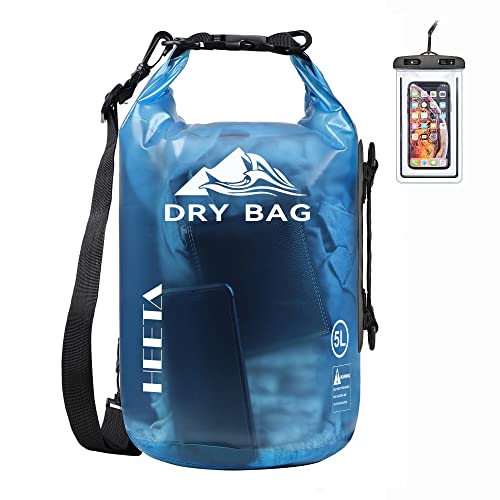
- Capacity5, 10, 20 or 30 L
- Material0.6 mm base, 0.3 mm sides
- Paneltransparent, so contents are visible
- Closureroll top
- Includedwaterproof phone case
- Colourseleven
- Strapadjustable shoulder strap
Best for: Anyone who hates unpacking a bag to find one item
Every opaque dry bag turns into a lucky dip. You want the sunscreen and you unpack a towel, a fleece and a lunchbox on a wet dock to find it.
A clear panel removes that entirely, and the graduated thickness is a sensible piece of design because the base is the part that grinds on the deck.
Buy a size larger than you think for a family trip. A 30 L takes towels for two paddlers plus safety kit with room to roll the closure properly.
Strengths
- Seeing the contents saves genuinely irritating time at the launch
- A thicker 0.6 mm base where the wear happens
- Twenty five dollars including a phone case
- Eleven colours, which helps if several bags are in the same car
Weaknesses
- Transparent means your valuables are on display on a busy beach
- Thinner 0.3 mm sides than the tarpaulin bags here

- Capacityup to 20 L, several sizes
- Material500D PVC
- Seamswelded
- Closureroll top with buckle
- Strapsingle adjustable strap
- Priceunder ten dollars
Best for: A second or third bag, or a first try at the idea
The cheap end of this category used to mean thin coated nylon that leaked at the seams. This is 500D PVC with welded seams for seven dollars, which is a different proposition.
What you give up is the carrying comfort and the extras, not the waterproofing, and for a bag that lives strapped to a deck that is the right trade.
Keep one permanently in your board bag. It weighs nothing and it means you never leave the house without one.
Strengths
- Under ten dollars for genuine 500D PVC and welded seams
- The same material as bags costing three times as much
- Light enough to keep permanently stuffed in a board bag
- Cheap enough that losing one overboard is annoying, not expensive
Weaknesses
- One thin strap, so it is not comfortable loaded
- No phone case, no pockets, no extras at all

- RatingIP68, submersible to one metre
- Buoyancyfloats with a phone inside
- MaterialTPU with a clear front
- Touchscreenworks through the case
- Lanyarddetachable
- Warrantyone year
- Fitsmost large phones
Best for: A phone that goes in the water with you, not on the deck
The phone is the item that actually gets destroyed. It is the one thing that goes in your pocket rather than the dry bag, and pockets are not waterproof.
A rated case that floats is worth the twenty dollars, because a sinking case with your phone in it is the same outcome as no case at all.
Wear it under a buoyancy aid rather than round your neck loose. Our life vest guide covers what to look for in the vest itself.
Strengths
- IP68 rather than an unrated claim, and it floats loaded
- Pelican back it with a warranty, which almost nobody in this category does
- Touchscreen and camera both usable through the front panel
- Detachable lanyard, so it can hang round your neck or clip to a leash
Weaknesses
- Twenty dollars for a single phone pouch
- Clear TPU eventually clouds with UV exposure

- Quantitytwo pouches
- RatingIPX8
- Buoyancyfloating padding built in
- Fitsphones up to 7 in
- Closuresnap and lock clips
- Lanyardneck strap included
- Priceunder ten dollars
Best for: Two paddlers, or one paddler who loses things
Phone pouches get lost, clouded and eventually cracked, which makes buying them in pairs the sensible approach rather than the cheap one.
The floating padding is the specification to check. Plenty of pouches are waterproof and none of that matters once one sinks in fifteen feet of lake.
Test any new pouch empty first. Seal it, hold it under, and look for a bead of water before your phone goes anywhere near it.
Strengths
- Two pouches for under ten dollars, so both people in a boat are covered
- Floating padding means a dropped pouch stays on the surface
- Fits the largest current phones
- Snap and lock closure is simple enough to work with cold hands
Weaknesses
- IPX8 without a dust rating, unlike the Pelican
- Thinner build, so treat these as consumables
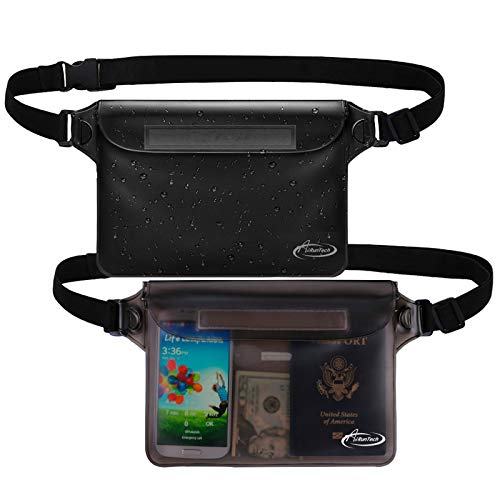
- Size8.5 x 5.8 in
- Closuretriple zip lock
- Depth ratingclaimed to 32 ft
- Fronttranslucent and touchscreen friendly
- Beltadjustable, fits most waist sizes
- Holdsphone, keys, cards, passport
- Buoyancyfloats
Best for: Keys, cards and a phone that stay on your body
Car keys are the item that ruins a session, and they are exactly the item most likely to be in a pocket rather than a dry bag on the deck.
A waist pack solves that by keeping the small critical things on your body, where a capsize simply cannot separate you from them.
Check how it sits with your other kit before a long paddle. A waist belt and a waist leash compete for the same few inches, and the leash wins.
Strengths
- Worn rather than carried, so there is nothing to fall off the board
- Triple zip lock rather than a single seal
- Touchscreen usable through the translucent front
- Twelve dollars for a bag that replaces both a pouch and a pocket
Weaknesses
- Small, so it holds essentials and nothing more
- A waist belt sits awkwardly under some buoyancy aids
How to choose a dry bag for paddle boarding
Buy two sizes, not one big one: A 20 to 30 litre bag holds a towel and a change of clothes, and a 5 litre holds the things that must not get wet. Packing valuables in a large half empty bag means unrolling the whole thing every time you want a snack.
Check the material, not the litres: The bags here run from thin coated fabric to 500D PVC tarpaulin. On a board, abrasion against the deck and the fin box kills bags long before the closure fails, so the heavier material is what buys you years.
Take ratings seriously for electronics only: A roll top sack has no rating and does not need one, because it is sealed by geometry. A phone pouch does, and there is a real difference between a stated IP68 rating and a vague waterproof claim.
Roll the top at least three times: This is the single most common reason a dry bag leaks. One or two folds is not a seal, it is a lid. Three full rolls with the air pressed out first, then clip the buckle across, and the bag will also float rather than fill.
Think about how it attaches: A bag that cannot be secured to the board is a bag that ends up in the water. Look for a bag that fits under your bungee, or plan to clip it to a D-ring, and never rely on it simply sitting on the deck.
Frequently asked questions
Are dry bags actually fully waterproof?
A properly rolled dry bag will keep the contents dry through a capsize and a swim to shore. It is not a submersible container, so it will eventually seep if held underwater for a long period at depth. For a phone or a camera, use a rated pouch inside the bag rather than trusting the sack alone.What size dry bag do I need for a day of paddling?
Twenty litres covers a towel, a fleece, lunch and a water bottle for one person. Thirty to forty is right for two people or for carrying a wetsuit. Add a 5 litre for keys, wallet and phone so the small things are not buried.Will a dry bag float if it goes overboard?
If you rolled it three times with air trapped inside, yes, and most of the bags here advertise it. A bag packed completely full with the air squeezed out will sit much lower and can sink once it takes on any water. Leave a little air in deliberately.How do I stop a dry bag sliding off the board?
Run it under the front bungee cord with the roll facing aft, or clip the buckle to a deck D-ring with a small carabiner. On a board with no bungee, a cam strap around the bag and through the front handle works, and neither method costs more than a few dollars.Bottom line
For most paddlers the Earth Pak 20L is the bag to buy once and stop thinking about, since the heavy tarpaulin is what survives years on a deck and the included phone case covers the item most likely to be ruined. If you walk any distance to the water, spend the extra on the MARCHWAY backpack instead and carry it properly.
The cheap options are genuinely worth owning alongside, not instead. A seven dollar Unigear sack lives permanently in the board bag, and a floating pouch keeps a phone safe for the price of a sandwich, which is the part of this list that actually prevents an expensive afternoon.


